



Components of Criminal Law – Understanding the Foundation of Justice
Criminal law forms the backbone of any justice system. It ensures public safety, maintains order, and provides a legal framework to punish and prevent wrongful acts. To help individuals understand how criminal cases work, it is essential to know the key components of criminal law. These components define offences, outline rights, and establish procedures that guide every stage of a criminal matter.
Below are the major components of criminal law that play a crucial role in ensuring fairness and justice.
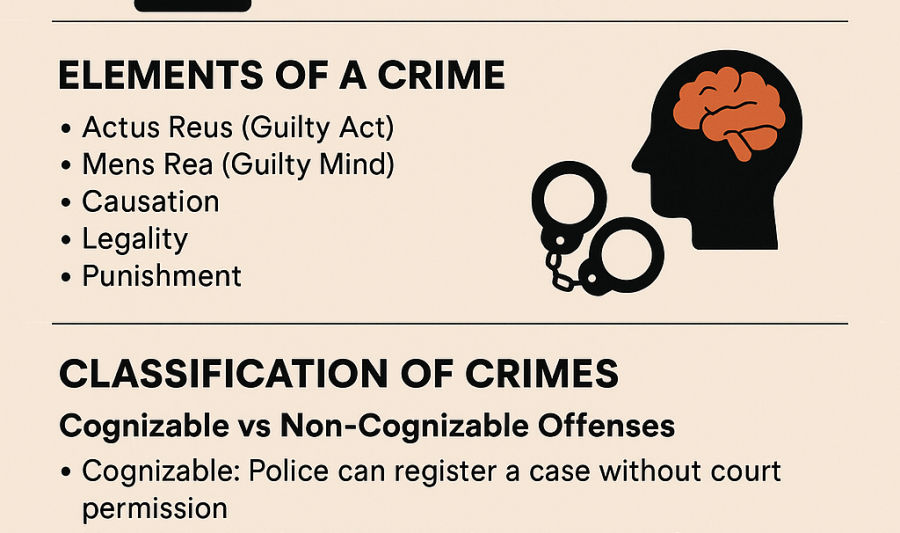
1. The Act (Actus Reus)
The first core component is the wrongful act itself. For any crime to exist, there must be a specific action, omission, or conduct that violates the law.
Examples include theft, assault, fraud, or causing harm through negligence.
2. The Intent (Mens Rea)
Along with the act, the criminal intent behind the action is equally important. Mens rea refers to the mental state of the accused at the time of committing the offence.
It helps determine whether the act was intentional, reckless, negligent, or accidental.
3. Concurrence of Act and Intent
For a crime to be established, both the act and the intent must exist together. This ensures that a person is not punished for an act committed without criminal intent.
4. Causation
Causation means the accused’s actions must have directly caused the harm or damage.
For example, in assault cases, the prosecution must prove that the accused’s act led to injury.
5. Harm or Injury
Every criminal offence involves some form of harm, whether physical, financial, emotional, or societal. Establishing harm is essential to determine the seriousness of the offence and the penalty.
6. Legality
Criminal law works on the principle of “no crime without law”.
An act can be punished only if it is already defined as a crime under existing law. This ensures fairness and prevents arbitrary punishment.
7. Punishment
Each criminal offence carries a specific punishment under the law—ranging from fines and community service to imprisonment. Punishment is necessary to deter crime and uphold justice.
8. Burden of Proof
In criminal cases, the prosecution must prove guilt beyond a reasonable doubt. This high standard protects individuals from wrongful convictions and ensures fair trials.
9. Defences in Criminal Law
The law allows several legal defences, such as self-defence, consent, duress, insanity, or mistake of fact. These defences protect innocent individuals and ensure balanced justice.
Conclusion
Understanding the components of criminal law helps individuals recognise their rights, obligations, and the seriousness of criminal offences. Whether you are dealing with a legal issue or seeking guidance, knowing how criminal law works ensures informed decision-making and better protection of your interests.